Guides
Is Your Sub-Zero Compressor Running? How to Check It
To check if a fridge compressor is working, listen for a steady hum at the machine compartment, feel for warm air coming out of it and confirm the fresh-food side holds 38 to 40 °F. Here is what each result means on a Sub-Zero, and when to call.
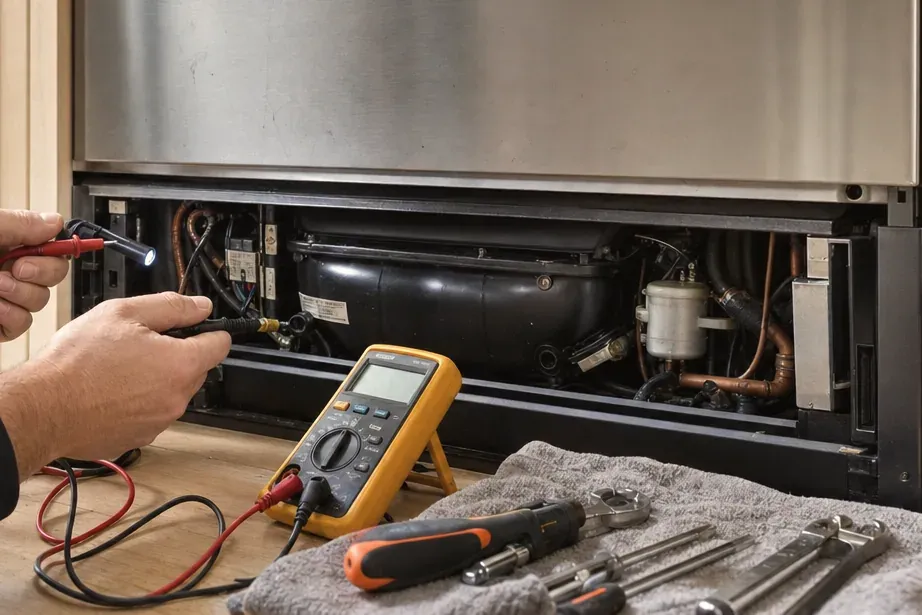
You can tell whether a fridge compressor is working with three quick checks. Listen at the machine compartment for a low, even hum; hold a hand near its grille to feel for warm air once the unit has been running a while; and confirm with a thermometer that the fresh-food section settles between 38 and 40 °F. Hum, warmth and a steady temperature together mean the compressor is doing its job. Silence, a cool compartment and a thermometer that keeps creeping up mean it is not running, although the real cause is often a start part, a fan or the control rather than the compressor itself. Broomfield summers are hot and dry, and a built-in working through a warm July afternoon runs longer cycles, so a weak compressor tends to give itself away in that season first.
What the compressor actually does
Think of the compressor as the pump of the sealed system. It squeezes refrigerant vapor into a hot, high-pressure gas and drives it through the condenser, where the heat leaves the cabinet. The refrigerant then expands inside the evaporator and pulls heat out of the food compartments before returning for another lap. Because it cycles on and off with demand, a quiet compressor is not automatically a dead one; it may simply be resting between cycles.
Where you listen depends on the model. On a Sub-Zero Classic built-in, the condenser sits up top behind the flip-up grille. On a Designer integrated unit it hides behind the kickplate, which is held on by two screws. The compressor shares that machine compartment, so that is where the evidence is.
Four checks you can make without tools
- Listen. Stand close to the grille or kickplate a few minutes after the door has been shut. A healthy compressor gives a low, even hum, sometimes with a faint vibration you can feel through the panel. A click, a few seconds of buzzing and then silence, repeating every few minutes, usually means it is trying to start and failing. Our note on a single click versus a steady chatter explains each pattern, and the sounds a Sub-Zero makes on a normal day helps you rule out the harmless ones.
- Feel. While the unit runs, air drifting out of the machine compartment should be noticeably warm. Keep your fingers outside: the compressor shell can be hot enough to burn, and the condenser fan can start without warning.
- Measure. Drop a thermometer into a cup of water, set the cup on a middle shelf and leave it alone for 5 to 8 hours. A reading of 38 to 40 °F is right. If you change the setting, wait another 5 to 8 hours before judging again. This beats any touch test because it shows whether cooling is keeping pace.
- Compare the two sides. Many Sub-Zero built-ins have a separate compressor for each compartment, so a frozen freezer next to a warm refrigerator does not clear the refrigerator side’s compressor.
Light on, cooling off, and the reverse
The interior light and the compressor share a power cord but not a control path. A bright cabinet proves only that electricity reaches the unit; it says nothing about the start relay, the compressor windings or the board that tells the compressor to run. A lit but warm fridge is therefore a cooling fault, and the checks above are where to begin.
The opposite case, cold food in a dark cabinet, is almost never the compressor. Most often it is a bulb, an LED board or a door switch. On Sub-Zero Classic (CL) and Designer (DET, DEC) units there is a deliberate explanation too: if a door or drawer has been left ajar, the control turns the lights off so they add no heat. Close everything firmly and allow one hour before deciding something is broken. On a 648PRO, EC 91 on the display flags a problem in the lighting system itself, and Sub-Zero gives owners no troubleshooting steps for that code.
What the display may already be telling you
Read the control panel before anything else. On a Classic (BI) unit, 60 1 60 or 60 2 60 means the control found no load from the refrigerator or freezer compressor: it called for cooling and saw nothing draw power. 60 1 38 and 60 2 38 are communication errors with the variable speed compressor, and 95 1 00, 95 1 01, 95 2 00 and 95 2 01 report a microcompressor pin stuck off or on. Sub-Zero’s direction for these is consistent. Switch the home breaker off for 30 seconds, switch it back on, watch whether the fault returns, and call for service if it does.
Fan faults carry their own 35 codes, such as 35 F 33 or 35 F 34 for the freezer evaporator fan and 35 r 34 for the refrigerator one. They matter here because a stalled fan can make a perfectly sound compressor look guilty.
Why the compressor is often not the culprit
A compressor that will not run is frequently one that is not being asked to run, or cannot get started. Typical causes, roughly from cheapest to dearest:
- A dust-matted condenser that makes the compressor overheat and trip its overload. Sub-Zero says a unit under 6 months old does not need this cleaning. On older units, turn power off at the control panel, put on gloves and vacuum with a soft brush following the direction of the fins.
- A stopped condenser or evaporator fan, so the compressor runs but heat never moves. Fan motor jobs typically land between $330–$680.
- A failed start relay or overload, the click-then-quiet pattern described above.
- A control board that no longer sends the run signal, typically $410–$940.
- The compressor or sealed system itself.
Cleaning has a limit. Once the fresh-food side reads above 48 degrees with the control set to 38, Sub-Zero’s own advice is that clean coils alone will rarely bring it back, so put the vacuum away and book a diagnosis.
Where homeowner testing should stop
Sound, warmth, a thermometer and the display are safe for anyone. Testing the compressor’s electrical terminals is different: it means cutting power, opening covers in the machine compartment and reading resistance with a meter, and a misread result sends people shopping for parts they never needed. Anything touching refrigerant is technician work, full stop. Current Sub-Zero guides warn that the units hold flammable refrigerant and that only technicians trained on that type should service them.
If the sealed system does need work, it typically costs $1,290–$3,100, with a firm figure once the fault is confirmed. That is still far less than replacing a built-in, which is why diagnosing first makes sense. Our $89 visit covers tracking down the fault, and the full $89 is credited toward any repair you approve. SubZero Repair Broomfield covers Broadlands, Anthem, McKay Landing, Wildgrass and Interlocken. See refrigerator and freezer repair in Broomfield or call (720) 704-2791.
Common questions
- Why is my fridge light not working but the fridge is working?
- Usually the light circuit has failed while the cooling side is fine: a bulb, an LED strip or a door switch. On Sub-Zero Classic (CL) and Designer (DET, DEC) units there is a second reason. If a door or drawer was left ajar, the control shuts the lights off to cut excess heat. Close every door firmly, wait one hour, and only then call for service.
- Why is the fridge not working but the light is on?
- A lit cabinet only proves that power is reaching the unit; the cooling side has stopped somewhere between the control, the start relay, the fans and the compressor. Listen at the grille or kickplate for a hum, feel for warm air and check the display for a code. Diagnosis with SubZero Repair Broomfield is part of the $89 visit, and that $89 is credited if you go ahead with the repair.
- Why did my fridge light stop working after the door was left open?
- On many Sub-Zero units that is deliberate, not a fault. Classic (CL) and Designer (DET, DEC) models switch the interior lights off when a door or drawer stays ajar, so the bulbs add no heat while warm kitchen air is already getting in. Shut the door properly and give it one hour; if the lights stay dark after that, book a visit.
- Can I test a fridge compressor myself?
- Yes, up to a point: listening for a steady hum, feeling for warm air from the machine compartment and running a thermometer test are all safe homeowner checks. Electrical tests at the compressor terminals and any work on the sealed system belong to a technician, and Sub-Zero warns that its current units contain flammable refrigerant that only specially trained technicians should handle.
- Why is my Sub-Zero freezer cold but the refrigerator warm?
- Many Sub-Zero built-ins run two separate cooling systems, so the freezer can stay frozen while the refrigerator side has a fault of its own. On a Classic (BI) unit the display keeps them apart: 60 1 60 points at the refrigerator compressor and 35 r 34 at the refrigerator evaporator fan. Reset the breaker for 30 seconds, then call if the code comes back.